Watch...
Showing posts with label BQ. Show all posts
Showing posts with label BQ. Show all posts
Wednesday, June 4, 2014

Tuesday, April 22, 2014
BQ#4 Unit T Concepts 1-3 Tangent & Cotangent graphs
Why is a “normal tangent graph
uphill but a “normal” cotangent graph downhill?
The graphs for
tangent and cotangent are in every single way bit for some reason they end up
looking weird at the end. This is because of the way their asymptotes are
formed. We know that tangent and cotangent are (+) in quadrants 1 & 3, and
(-) 2 & 4. To understand this more, remember that to get an asymptote the
trig ration must be undefined to have an undefined ratio you need to divide by
zero.

For tangent,
we know the ratio is Y/X so... to get an asymptote X must equal to zero. This means
to will have asymptotes at pi/2 & 3pi/2. So the graph of tangent cannot
touch these lines, but somehow it must be are in quadrants 1 & 3, and (-) 2
& 4. The only way to draw this is making it look like it is going “uphill”

Cotangent, we
know the ratio is X/Y so… it will have asymptotes wherever cos=0 or y=0. This means
the graph will have asymptotes at 0, pi, 2pi. The only way to graph this is how
we did it above, giving it a “downhill” looking graph.
Monday, April 21, 2014
BQ #3: Unit T Concept 1-3
How Do The Graphs of Sine and Cosine Relate To Each of The Others?
 |
| 2nd quadrant |
 |
| 1st caption |
The graphs of sine and cosine relate to the others through
their asymptotes. If you remember, we can think of a graph as an unraveled unit
circle. If we think of it like this than sine and cosine can relate to the
other functions through the quadrants. Another thing that will help us bring
everything full circle are the trig identities. If you need reference to the graph on desmos you can click here courtesy of Mrs. Kirch
Tangent?
One thing that will aid the
explanation of this is are the trig identities. Recall that tan= sin/cos if you
take a look at the graph the green (sin) and red (cos) lines are positive
because they are above the x axis. If we use this in the identity it means that
is sin and cos are positive than tangent will be positive, as you can see this
is true because the tangent graph is above the x axis. In the second picture,
one of the graphs is positive one is negative giving it an overall negative,
this is the reason why the tangent graph is below the x axis. These are some of
the ways that the graphs relate.
Cotangent?
The explanation
for cotangent will be much more concise because it is based on the
rules as tangent. For the exceptions that the identity is cos/sin and the
asymptotes are shifted over. The asymptote will be at 0,pi, and 2pi. Also, The graph of cotangent has its asymptotes
based on sine.
Secant?
Secant relates to cosine
because it has asymptotes based on cosine its asymptotes are where cos is equal
to zero. This is because an asymptote is formed when secant is undefined, and
the ratio for secant is R/X to get this to be undefined X=0.
Cosecant?
The asymptotes of
cosecant are based on sine. It has asymptotes where sine equals zero because the
ratio must be undefined. The ration so cosecant is R/Y to get an asymptote Y=0
Saturday, April 19, 2014
BQ#5 - Concepts 1-3

From the picture above we see that sine and cosine are always divided by R wich means they will be divided by 1. This means that they cannot be undefined. Of your ratio isnt undefined then you wont have an asymptote. Other trig functions it is possible to have asymptotes because you can divide by 0. And, as we know dividing by zero equals undefined wich cause asymptotes in graphs.
Thursday, April 17, 2014
BQ#2 - Unit T Concept 2
How do trig graphs relate to the Unit Circle?
a. The period for sine and cosine is 2pi because thats is howl long it takes for the pattern to repeat. By pattern I mean for the positive and negative quadrant patterns. We know that a trig graph of sine is ++-- this means that the first to quadrants of the graph will be above the X axis and the othe will be under. Tangent /Cotangent however, will be pi because you only need one section for the pattern to repeat. The pattern for tangent/cotangent is +-+- however you only need +- because the pattern repeats already.
b. Sine and cosine have restrictions because the unit curcle is only goes up to. 1, -1, 0. For the same reason sine and cosine can only equal >-1 & <1. To quote Mrs. Kirch, " Sine and Cosine cannot bust through the restrictions."
Sunday, March 16, 2014
BQ#1 Unit P Concept 1 and 4: Law of Sines and Area Formula
1. Law of
Sines
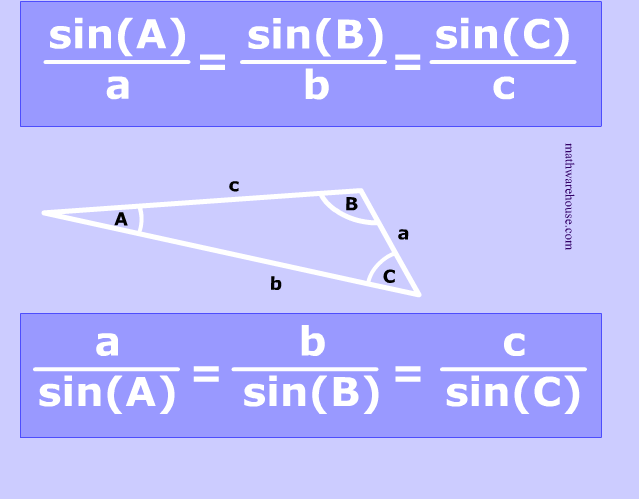 |
http://www.mathwarehouse.com/trigonometry/law-of-sines/images/formula-picture-law-of-sines2.png
|
Why do we need it?
- We need the law of sines because sometimes we are not dealing with right triangles. We don’t have the normal trig functions to solve non-right triangles. However, if we drop a perpendicular line h we can use the trig functions to help us solve the non-right triangles.
How is it derived?
- First, we cut the triangle in half. This reveals two right triangles within the non-right triangle. The law of sine’s are derived by taking the sine of angle A and angle C. we should end up with sinA= h/c & sinC= h/a Then we solve for h and simplify. This gives us c x sinA =h & a x sinC= h. If both equations are equal to h then they are both equal to each other. Now, to simplify this set a denominator of ac and cancel. You should end up with. SinA/a = SinC/c


2.
Area Formulas

- How is it related to the previously known formula? This formula is related to it because it is basically the same formula. The only difference is that we don’t know the value of h. to find the value of h we substitute (a x Sin C). In the next paragraph we will learn why and how we substitute this value.
- How is it derived? The area formula is derived by finding the value of h. we know the are of a triangle is A= ½ bh. We know that SinC=h/a we solve for h, h= a x SinC. Plug this into the formula, A= ½ b( a x SinC ).


Subscribe to:
Posts (Atom)